 Prayer Shrine Theory
By Dixon Spendlove
There is a Native American Tribe whose oral traditions seem to corroborate the existence of these glyphs.
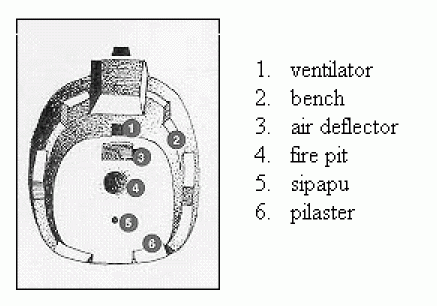
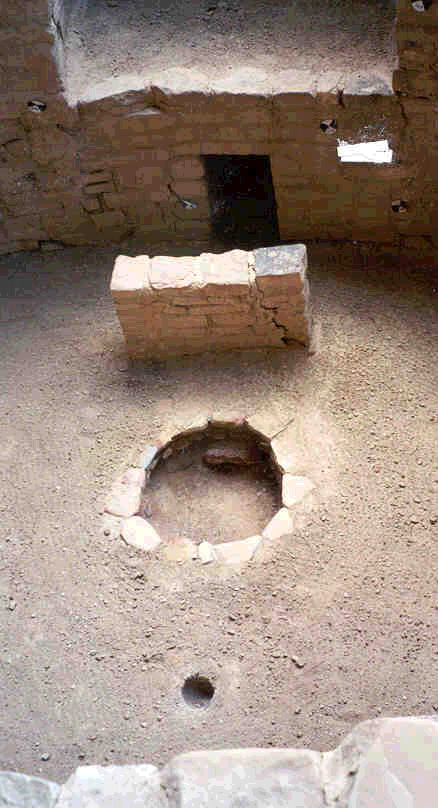
According to their story of emergence from the underworld, in the beginning they lived beneath the surface of the land, but they could hear "Masaaw" walking on the surface and they desired to emerge to the surface. To accomplice this they emerged by climbing thru a reed called the "Sipapu" in the Grand Canyon.
This tribe refers to a time before "roots were solidified" at the village of Old Oraibi as as their migrations period, when they were commanded by Masaau to make "marks upon the rock to show where they had traveled" and lived. Massau told them that these marks, on cliffs, were to be used in the last days as a land ownership claim for their people.
This tribe was also They were also commanded to make shrines, or holy places along the edge of cliff tops, to offer prayers to Masaau. With the hole in the circle being the sipapu and the straight line being the reed and the line always running to the edge of the rock... Could these symbols be ancient Anazasi shrines signifying their emergence from the Grand Canyon.
The team has found ( after returning to these glyphs many times over nearly twenty years) that several of these glyphs are still being used as tribal "holy places". For what should be obvious reasons of respect, no evidence of this is presented here.
However, the reader is strongly cautioned to tread cautiously with respect to these glyphs. You will be walking on sacred ground. Again, the Paleo-Hebraic theory offers some insight to this concept:
The Hebrew letter  written in Paleo-Hebraic is
  , Rabbin associate the Kolph with "Temple Offerings":
"If a man were to find a Jar with a
written on it, the contents were considered 'consecrated unto God'.
(Maaser Sheni 4:11) The key phrase here is
'Kodesh La HaShem'or 'Holiness
to the Lord' ".
It has also been suggested by Midrash Alpha Beit, that
"...since the temple (in Jerusalem) had been destroyed, and the offering no longer available to make our prayers effective, everyday [the faithful] should recite 100 blessings as a substitute."
What if instead of inscribing the symbol on the offering... the worshiper simply placed the offering on the inscription?
According to Hebrew Gemetria,
= 100.


| TEAM MEMBERS | WORKS CITED

CONTACT US @ WATER GLYPHS